
If you have arrived here after hearing, or searching for, the recent episode of the The Food Programme on honey, you are not alone.
The programme explored a question that unsettles many people once they begin to look closely at what is on supermarket shelves. What actually is honey today, and how much of what we buy really comes from bees?
The answers, as the programme made clear, are uncomfortable.
A global problem hiding in plain sight
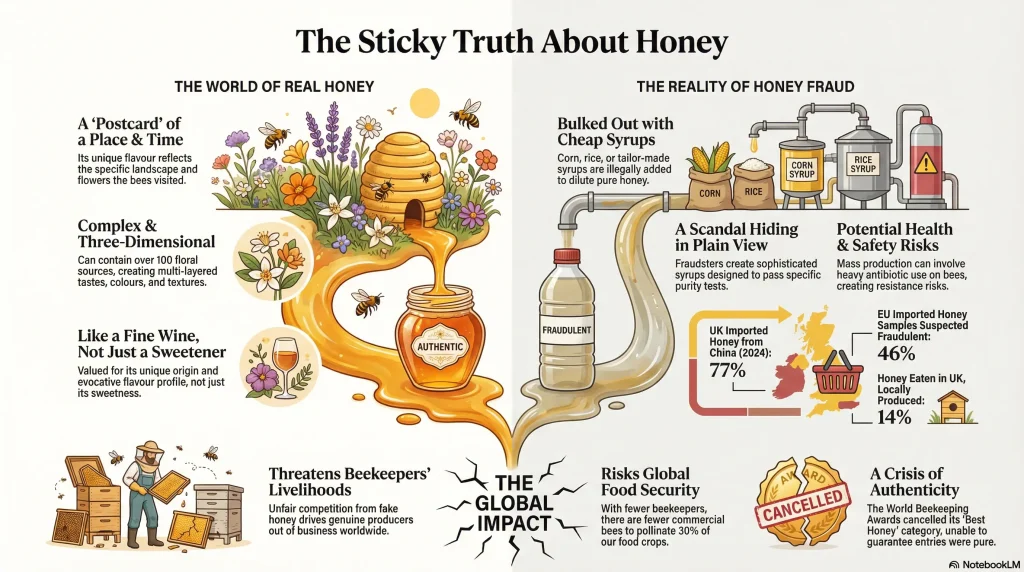
The episode laid out what many beekeepers have been warning about for years. Honey fraud is real, widespread, and increasingly sophisticated.
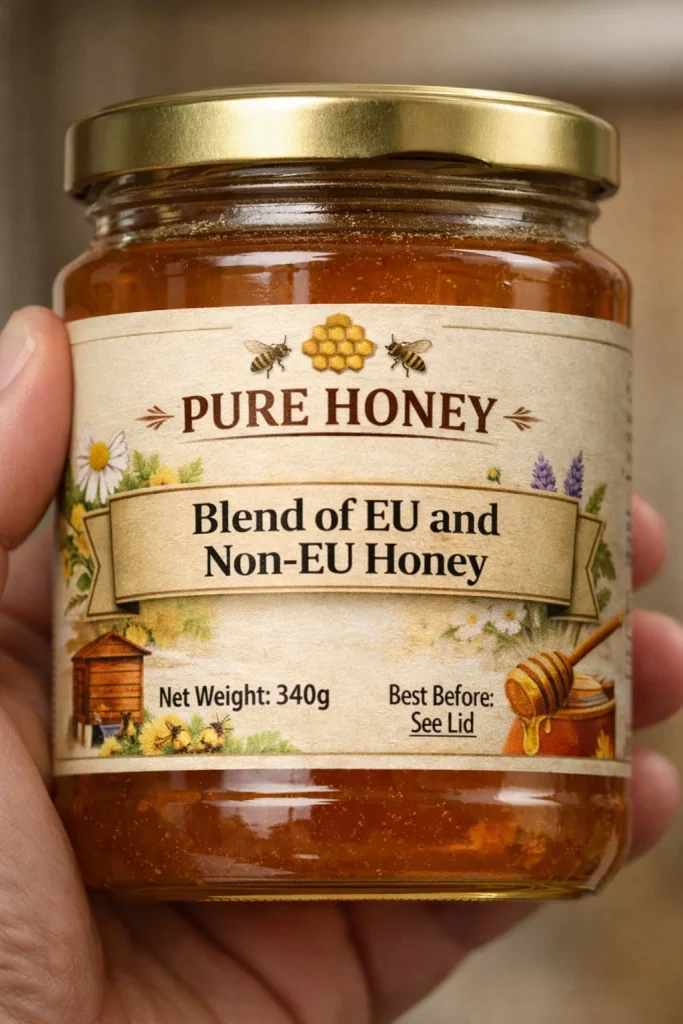
Much of the honey sold in the UK is imported. Labels often read “blend of EU and non-EU honeys” or “product of more than one country”, which sounds harmless until you understand what that allows. Vast quantities of honey are traded internationally, often at prices that would be impossible for a beekeeper relying on nectar alone.
Experts interviewed on the programme explained how modern adulteration no longer relies on crude corn syrup. Instead, tailor-made plant sugars are engineered to evade standard tests. Some syrups are even designed to mimic the chemical fingerprint of specific floral sources. Pollen can be filtered out and reintroduced. Markers can be synthesised and added back in.
This is not accidental contamination. It is deliberate, industrial food fraud.
Why testing alone cannot solve it
One of the most striking revelations in the programme was that there is no single test that can definitively prove honey is real.
Even the most advanced laboratories work with probabilities rather than certainty. A test that is 95 percent accurate still gives the wrong answer one time in twenty. Fraudsters know this and adapt faster than regulators can respond.
This is why the World Beekeeping Awards recently removed honey from their top prize categories. Judges could not guarantee that entries were genuinely honey. When even global competitions step back, it tells you how deep the problem runs.
What this means for beekeepers and food security
The programme made it clear that this is not just about what you spread on toast.
When honey prices are driven down by adulterated imports, commercial beekeepers struggle to survive. Across Europe, Asia, and the Americas, beekeepers are leaving the industry. When they do, bees disappear from orchards, fields, and crops that rely on managed pollination.
This is not abstract. Around a third of the food we eat depends on pollination by bees. If beekeeping becomes economically impossible, the consequences reach far beyond honey.
Taste tells the truth, even when labels do not
Several contributors to the programme, including international honey judges and professional tasters, returned to the same point.
Real honey has complexity.
It smells of place. It changes with season, weather, and landscape. It can be sharp, bitter, floral, resinous, or unexpectedly savoury. Adulterated honey tastes flat. Sweet, but empty. Sugar without story.
Once you have tasted genuine local honey, it becomes very hard to go back.
Why LocalHoney.uk exists
LocalHoney.uk was created precisely because of the issues raised in the programme.
When you buy local honey directly from a beekeeper, or through a platform that prioritises traceability, several things change immediately.
You know where the honey came from.
You know when it was harvested.
You know that the bees were foraging, not being fed syrup.
You know your money supports someone keeping bees in your landscape.
There is no need for heroic testing regimes when the supply chain is short enough to see.
Local honey does not need to be cheap to be honest. It needs to be real.
Why local honey costs more and why that is not a problem
The programme touched on a question many people ask. How can supermarket honey cost two pounds while local honey costs much more?
The answer is scale, labour, and biology.
British bees have a short season. Weather matters. Flowers matter. Beekeepers cannot force nectar flows or harvest year-round. When honey is priced honestly, it reflects that reality.
The comparison made in the programme was telling. Many people hesitate over the price of a jar of honey, then think nothing of spending the same amount on coffee or alcohol. Honey, perhaps more than any other food, is a direct product of landscape and labour.
If you are listening or about to listen to the programme
The BBC Food Programme episode is worth hearing in full. It gives voice to beekeepers, scientists, inspectors, and producers across the world, and it does not offer easy answers.
What it does offer is clarity.
Honey is no longer a simple product. If you care about what you eat, where it comes from, and how food systems work, honey is a place to start asking better questions.
Finding real honey near you
If the programme has made you pause in front of the honey shelf, you are exactly where many listeners end up.
LocalHoney.uk exists to help you take the next step.
Here you can find genuine British honey, learn how it is produced, understand why it tastes the way it does, and support the beekeepers who are still doing this work properly.
Honey should be, as one beekeeper in the programme described it, a postcard of a place and a time.
That is still possible. But only if we choose it.